
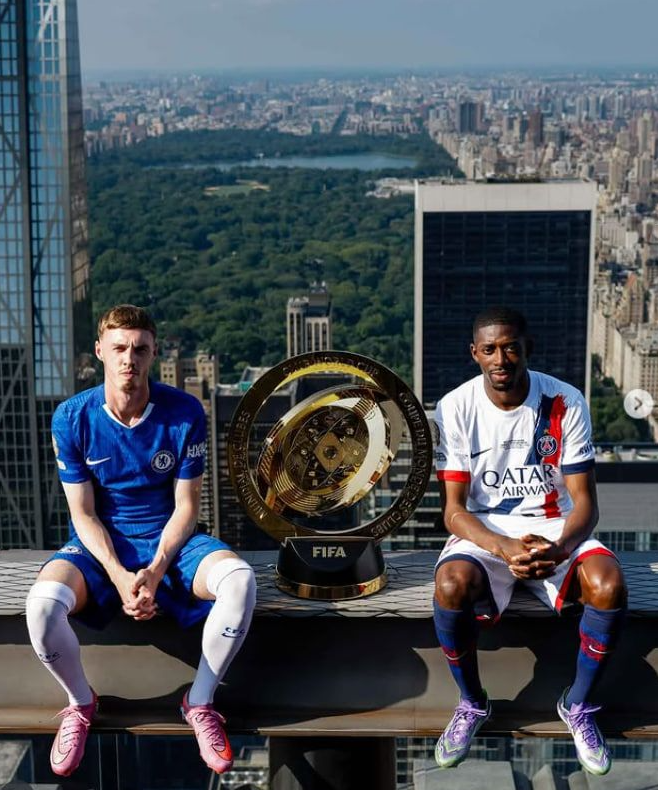
In the heart of Manhattan, two of football’s brightest stars — Ousmane Dembélé of Paris Saint-Germain and Cole Palmer of Chelsea — created a striking image that blended sport, culture, and the iconic New York skyline. Ahead of the highly anticipated FIFA Club World Cup final, the players climbed to the rooftop of the legendary Rockefeller Center, a 70-story skyscraper that has long stood as a symbol of ambition and glamour in the United States.
Wearing the official kits of their respective clubs, the two footballers posed together while proudly holding the gleaming Club World Cup trophy. The moment was designed not only as a promotional event for the tournament but also as a symbolic gesture: two European giants, standing above one of the world’s most famous cities, with the prize that both of their clubs are desperate to claim.
The Rockefeller Center rooftop is no stranger to iconic photoshoots, but rarely has it hosted a meeting of football’s rising superstars. Against a backdrop of sweeping views that stretched across Manhattan and beyond, Palmer and Dembélé stood side by side, the trophy catching the glint of the setting sun. The image was more than just a photoshoot. It was a carefully crafted celebration of football’s global reach. By choosing New York — a city often considered the crossroads of international culture — FIFA and the clubs highlighted the Club World Cup’s importance not just as a sporting competition but as a truly worldwide spectacle.
Fans passing by the skyscraper were treated to glimpses of the scene, and social media quickly lit up with posts and reactions. For Chelsea and PSG supporters, the photos served as both a reminder of the magnitude of the coming final and an inspiration, showcasing their stars in one of the most glamorous settings imaginable.Cole Palmer, still in the early stages of what promises to be a glittering career, has rapidly become a central figure for Chelsea. Since his transfer from Manchester City, he has earned praise for his composure, creativity, and ability to deliver in high-pressure situations. For a player of his age, standing atop one of the world’s most iconic buildings with a global trophy in hand represents both a milestone and a glimpse into a future where his influence could stretch even further.

On the other side stood Ousmane Dembélé, a player whose journey has been marked by flashes of brilliance, determination, and resilience. At PSG, he represents not only world-class technical skill but also the club’s determination to stay at the forefront of European and international football. His presence in New York alongside Palmer highlighted the mix of experience and youthful energy that the Club World Cup final will bring.
The pairing of these two players for the photoshoot was no accident. Each symbolizes a different narrative: Palmer, the emerging talent with everything still to prove, and Dembélé, the established star whose career has already seen dramatic highs and challenges. Together, they embodied the sense of drama and anticipation surrounding the final.
While the photoshoot itself made headlines, it also pointed toward the broader ambitions of the Club World Cup. FIFA has long sought to elevate the competition’s profile, positioning it as the definitive showdown of champions from different continents. Hosting promotional events in global cities like New York is part of that strategy, aimed at capturing the attention of fans beyond traditional footballing regions. By bringing Palmer and Dembélé to the Rockefeller Center, FIFA underscored the message that this is no longer a niche tournament but a global event that deserves to be celebrated with the same glamour as the Champions League or World Cup.
For Chelsea and PSG, the opportunity to represent Europe on this stage adds weight to their seasons, offering another chance to cement their status among the elite. The trophy itself, standing between the two players, told its own story. It is the culmination of years of effort, countless matches, and the hopes of millions of supporters. Holding it high above New York was not just a marketing stunt but a symbolic gesture — football at the top of the world, uniting fans across continents.


